 Top Trending
A Small Morning Bottle: 55 Milligrams of Caffeine, Five Vitamins and Nine Names
Magic Mind Original is a green bottle from Venice, California, kept in the fridge: matcha, vitamins C, D and three Bs, and a 1,925-milligram blend of nine plants and compounds. I read the panel, the trials and the reviews.

This is a paid advertisement. Sponsored by 10,000 Inc. (Magic Mind).

Marcus Hale is the pen name of this desk.
The customers quoted on this page are real; their reviews are public on the seller's product page and were read there on September 9, 2026.
I haven't met them and know nothing about them beyond what they wrote.
The small photos beside their reviews are illustrations, not the reviewers.
Everything about the bottle, from the panel to the refund terms, comes from the seller's own label file and pages, read the same day.
I don't trust anything with a conjuror's word on the front, and I bought fifteen of these to find out whether I was wrong.
Here's the honest shape of what I found, and the rest of this page is the detail.
The panel prints a number for every vitamin: 100 milligrams of C, 25 micrograms of D, a milligram of B2, 8 of B3, 2.4 micrograms of B12, each with its percent of the day.
Then it prints one more line: a proprietary blend, 1,925 milligrams, with nine names on the listing and not one amount.
So the panel tells you exactly how much vitamin C you're drinking, and refuses to tell you how much lion's mane, bacopa or citicoline.
That asymmetry is the whole review.
The one number the seller does give for the blend is the caffeine: 55 milligrams, from the matcha.
That's about half a cup of coffee, and it's the one line on this bottle with a track record.
One small bottle in the morning, fifteen to a box. Every number on this page is for that bottle, and the numbers that aren't on the label are the point.
Here's what the bottle is.
Magic Mind Original, from a company registered as 10,000 Inc. in Venice, California, sold in boxes of fifteen, thirty or sixty little bottles that the seller says to keep cold.
The panel, from the seller's own label file: 25 calories, a gram of fat, four grams of carbohydrate, three grams of sugar, all of it added.
Vitamin C, 100 milligrams.
Vitamin D3, 25 micrograms.
Riboflavin, one milligram.
Niacin, 8 milligrams.
Vitamin B12, 2.4 micrograms.
And then: "Magic Mind Nulixer, patented mental performance formula, 1,925 milligrams," with the daily-value column showing an asterisk.
The listing names what's in that blend: lion's mane, bacopa, citicoline, L-theanine, ceremonial-grade matcha, rhodiola, cordyceps, ashwagandha and turmeric.
It doesn't say how much of any of them.
It does say the Original has 55 milligrams of caffeine, and that there's a with no caffeine version and a stronger one.
I did what I always do.
I read the label before the listing.
I read the trials behind each name in the blend, at the doses they actually used, in people as old as I am when such trials exist.
I read the reviews, all ten the page gave me, and kept the two-star one.
And I read the refund page, which is one of the best I've read and applies exactly once.
What I found is a well-made little drink with five honest vitamin lines, half a cup's worth of caffeine, three grams of sugar, and a blend of nine good names whose amounts the seller keeps to itself, so that not one of them can be set beside the trial that made it worth naming.
The Small Slips That Come With an Ordinary Morning
Let's start somewhere familiar, because I'd bet it's familiar to you too.
You're at the hardware store, a man you've known for twenty years waves from the paint aisle, and his name just isn't there.
It comes back in the parking lot, of course.
It always does, about four minutes too late to be any use.
Or you're reading the paper after breakfast, you reach the bottom of a column, and you've no idea what the top of it said.
So you go back up and read it again.
Or you walk into the garage with a clear purpose, stand at the workbench, and wonder what on earth the purpose was.
Sound like anyone you know?
If it does, you're in very large company.
Most men I know past sixty tell the same three stories, usually laughing, sometimes not quite.

There are other versions, and you'll recognize at least one.
The actor in the old western on a Sunday afternoon, whose face you know as well as your brother's and whose name won't come.
The phone in your hand while you look for the phone.
The grandson's new teacher, whose name you were told twice at dinner.
The second paragraph of a letter from the insurance company, which you've now read three times and could not summarize to save your life.
And the list you left on the kitchen counter, so you're standing in the grocery store trying to picture it.
Why does this happen more now than it did at forty?
Part of it is plain arithmetic: you've met more people, read more pages and walked into more rooms than you had at forty.
Part of it is attention.
When you're half listening to the radio, half watching the road and half thinking about the bill on the counter, a name never gets filed properly in the first place.
And part of it is simply the morning itself.
Some mornings you wake up ready, and some mornings the first hour feels like walking through wet sand.
I'm not going to tell you those moments mean something dark.
They mostly mean you're a busy man with sixty-odd years of names on file, and the file takes a second longer to open than it used to.
What they do tell you is that mornings matter more than they used to.
The first couple of hours are when you read, plan, drive, pay the bills and have the conversations that need your full attention.
And that's the window this little bottle is sold for.
Not a lifetime, not a promise, just a morning.

So here's the question this page is really about.
Is a small cold bottle a sensible part of a good morning, or is it just an expensive half cup of coffee?
I'll give you everything I found, the good and the not so good.
You can decide over your own coffee.
Why Another Cup of Coffee Only Takes You So Far
Now, the first thing most of us reach for on a slow morning is a second cup.
And honestly, that's not a bad instinct.
Caffeine is the best-understood thing anyone can put in a mug.
The European food-safety authority's own conclusion is that moderate amounts increase alertness. [1]
Keep that in mind, because we'll come back to it.
But you already know the catch.
The second cup helps.
The third makes your hands busy and your stomach sour, and the fourth follows you into the evening.
The Food and Drug Administration puts the everyday line at about 400 milligrams a day for most healthy adults. [2]
A twelve-ounce cup of brewed coffee can hold anywhere from 113 to 247, so two big diner mugs get you most of the way there before lunch.
More coffee is a blunt tool. It turns up the volume on everything, including the parts you'd rather it didn't.
So why not just drink the same coffee and leave it there?
You can, and plenty of sensible men do.
The trouble is timing.
The pot you make at six is mostly gone by nine, and by the time you sit down to the part of the morning that needs you, you're either on the next cup or running on the memory of the last one.
Then there's the afternoon.
A cup at three feels like a good idea at three and a poor one at eleven that night, when you're staring at the ceiling.
What most of us really want isn't more caffeine; it's the right amount at the right hour.
That's a smaller, duller goal than anything on a label, and a much more useful one.
The other usual answers are the good ones, and they cost nothing.
Water, for one.
In a Berlin study of 1,111 adults aged 60 to 89, the ones who were measurably short on fluids did worse over time on a test of processing speed. [3]
That's an association, not proof, but a glass of water before the coffee is about the cheapest habit on earth.
A proper night's rest, a walk before breakfast, a real breakfast instead of a pastry, and a conversation with people you like all belong on the same list.
None of that comes in a bottle, and I'd never tell you to swap any of it for one.
What some men want is something in between.
Less than a pot of coffee, a bit more thought-out than a doughnut, and quick enough to drink standing at the fridge.
That's the spot Magic Mind is aiming at.
So let's look at what's actually in it.
So What Is This Little Green Bottle?
Here's the bottle in plain terms.
Magic Mind Original is a small green glass bottle of two fluid ounces, about the size of a hotel shampoo, sold in boxes of fifteen, thirty or sixty.
It comes from a company registered as 10,000 Inc., on Electric Avenue in Venice, California, with a phone number that answers on Pacific time.
You keep the box in the fridge door, and you drink one bottle in the morning.
The drink is green, grassy from the matcha, a little sweet and a little bitter.
It's gone in two swallows.
So what does the panel actually say?
Here it is, per bottle, from the seller's own label file.
- Twenty-five calories, one gram of fat and four grams of carbohydrate.
- Three grams of sugar, all of it added, six percent of the day.
- Vitamin C, 100 milligrams, 111 percent of the Daily Value.
- Vitamin D3, 25 micrograms, 125 percent.
- Riboflavin, the B2, one milligram, 77 percent.
- Niacin, the B3, 8 milligrams, 50 percent.
- Vitamin B12, 2.4 micrograms, 100 percent.
- One proprietary blend of 1,925 milligrams.
And what's in that blend?
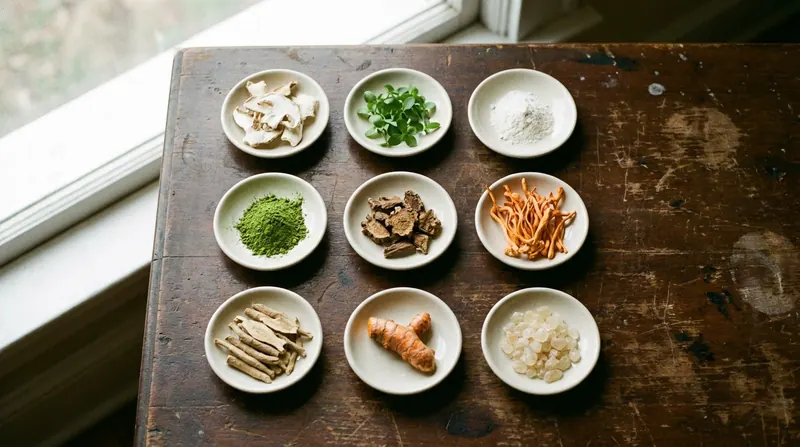
The listing names nine things: lion's mane, bacopa, citicoline, L-theanine, ceremonial-grade matcha, rhodiola, cordyceps, ashwagandha and turmeric.
What the label doesn't print is how much of each one is in there.
That's common with blends, and it's the one thing I'd change about this label if anybody asked me.
The seller does give one figure for the blend: 55 milligrams of caffeine, from the matcha.
The directions are one bottle a day in the morning, and the seller suggests the Original for people who use a moderate amount of caffeine.
Five vitamins with a number and a percent each, one caffeine figure, and one blend with nine names and a total weight. That's the whole bottle, and now you've read it the way I did.
A Word About the Name on the Box
Let's get this out of the way, because I know what you're thinking.
A grown man reads the word on the front of this box and his eyebrows go up.
Mine did too.
That's why I bought fifteen and read the back of the box before I read a single line of the seller's page.
So does the name mean anything?
No, it's a brand name, the same way nobody expects a Mustang to gallop.
What counts is what's printed on the panel, who stands behind it, and what the refund says.
Judge the bottle by its back, not its front, and you'll never be sold a name again.
That's the approach for the rest of this page.
No adjectives from the listing, just the numbers, the studies and the people who bought it.
Fifty-Five Milligrams, or About Half a Cup of Coffee
I'll take the caffeine first.
It's the line that will do the most, and it's the one everybody already understands.
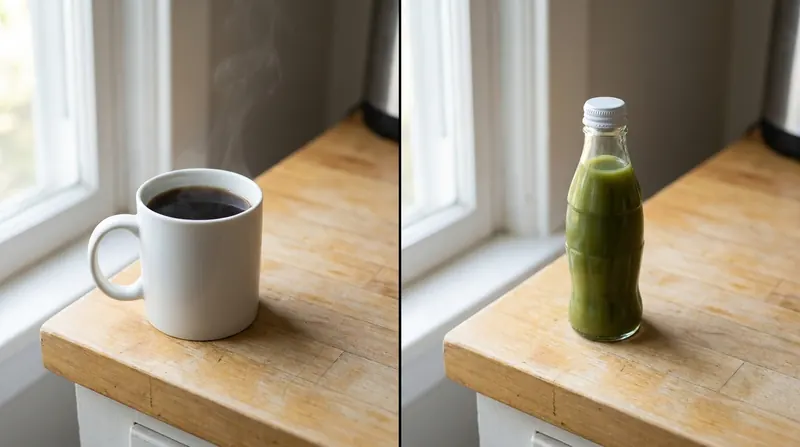
Fifty-five milligrams per bottle, the seller says.
An ordinary cup of brewed coffee usually carries more than that, and a cup of tea often a little less.
So a bottle is about half a coffee, or a strong cup of tea.
That's the number Bill, the two-star reviewer you'll meet further down, guessed without ever seeing it.
What does that much caffeine actually do?
The same thing your coffee does, at half the volume: moderate doses increase alertness and reduce sleepiness, in the European regulator's words. [1]
It's also an eighth of the daily amount that regulator raises no concern about.
That's a comfortable margin, as long as you count the bottle along with your coffee.
Is there anything to caffeine that comes with theanine, the way it does in tea?
There's one small study worth knowing about.
In 27 healthy volunteers, a single dose of 50 milligrams of caffeine with 100 milligrams of L-theanine went with faster, more accurate work on an attention-switching task an hour later, compared with a placebo. [4]
Caffeine by itself mostly moved how alert people said they felt.
That caffeine figure is close to this bottle's.
The theanine figure isn't printed, so I can't tell you it matches, only that the pairing has been studied and that matcha naturally carries both.
Fifty-five milligrams of caffeine is the bottle's track record. If you feel the bottle, this is most of what you're feeling.
Count it with your coffee.
A bottle on top of two cups is two and a half, and it's worth keeping all of it before two in the afternoon.
Is there anything to watch for with caffeine at our age?
The same things you already know from coffee, just smaller.
The Food and Drug Administration lists what too much caffeine can bring: a faster heartbeat, jitters, an upset stomach, a headache, and a restless night. [2]
It also says some people are more sensitive than others, and that anyone who takes medicines should talk it over with a health care provider.
At 55 milligrams, one bottle is a small amount.
Two bottles and a pot of coffee is not, and that's the man I'd worry about.
Where else does caffeine sneak in?
Iced tea at lunch, a cola, a piece of dark chocolate in the afternoon, and the "decaf" that isn't quite zero.
None of those is a problem on its own.
Added together with a bottle and two mugs, they're the reason the two o'clock rule exists.
Five Vitamins, Printed Plainly
This is the honest half of the panel, and the shortest section.
A hundred milligrams of vitamin C is a little more than a day's need; an orange has about 70.
Twenty-five micrograms of vitamin D3 is a thousand international units, a common daily amount.
The three B vitamins sit at or near a day's need each: riboflavin 77 percent, niacin 50, B12 100.
The label prints each against the Daily Value, and the arithmetic checks out. [5]
Will those vitamins sharpen a man who already eats well?
Probably not, and I'd rather you heard it from me.
A 2018 Cochrane review of 14 trials in 27,882 adults with healthy thinking found that B-vitamin supplements probably make little or no difference to overall thinking scores over five years. [6]
And a three-year trial in 2,157 adults over 70 who took 2,000 units of vitamin D a day found no change on its thinking score. [7]
So read these five lines as what they are: a day's worth of five vitamins in a cold drink.
Handy if your diet runs thin, and nothing more than that.
If you wonder whether you're low in B12 or D, that's a simple blood test and a conversation with your clinician.
How to Read a Label Like This One in Two Minutes
Before we get to the blend, let me give you the three questions I ask any label.
They work on this bottle, and they'll work on the next thing somebody tries to sell you.
Question one: is there a number beside every name?
A name with a number can be checked; a name without one can only be trusted.
On this bottle, the vitamins and the caffeine have numbers.
The nine names in the blend share one total and no individual amounts.
Question two: what does the percent mean?
The Daily Value is the amount the Food and Drug Administration uses as a day's reference for each nutrient on the label. [5]
So 100 percent of B12 means a day's reference amount, not a dose that does anything extra.
More than 100 percent, like the vitamin D here, simply means a little over that reference.
Question three: which line would you feel?
On almost any morning drink, it's the caffeine, and on this one it's printed plainly at 55 milligrams.
If a label passes those three questions, you know what you're buying.
This one passes two and a half, and I'd rather you knew which half is missing.
Numbers beside names, percents read as a day's reference, and the caffeine line first. That's the whole skill, and it takes about two minutes.
The Nine Names in the Blend, One at a Time
This is the line the whole bottle is sold on.
So let's go name by name, and for each one ask the fair question: what was it tested for, and at what amount?
Lion's mane: what was it tested for?
In a twelve-week trial of 31 healthy adults over 50, 3.2 grams a day of the dried mushroom went with higher scores on a standard mental-status test than a placebo. [8]
That's more than the whole blend weighs.
So whatever lion's mane is in the bottle, it's less than that trial used.
What about bacopa?
In adults 55 and over, 300 milligrams a day of a standardized extract for twelve weeks went with better delayed word recall than a placebo. [9] [10]
A review of nine bacopa trials pointed mostly to speed of attention, and asked for a larger study to settle it. [11]
Three hundred milligrams would be about a sixth of the blend, if bacopa had it all.
And citicoline?
In 100 healthy adults aged 50 to 85 who felt their memory had slipped with age, 500 milligrams a day for twelve weeks went with better scores on one memory test than a placebo. [12]
Both groups improved on the overall memory score, which is worth knowing too.
Five hundred milligrams would be a quarter of the blend.
L-theanine?
In Japanese adults aged 50 to 69, a single dose went with faster reactions on an attention task. [13]
Matcha?
It's powdered green tea, the source of the caffeine, and the National Institutes of Health reminds people who take anything daily to mention green tea products to a clinician. [14]
Rhodiola?
Its best-known trial was in young clinicians working nights, with a standardized extract that has its own name. [15]
Ashwagandha?
A single 225-milligram dose, and thirty days of it, in 59 healthy young adults, went with better scores on some parts of a test battery. [16]
Turmeric?
An eighteen-month trial in 40 adults aged 51 to 84 used 90 milligrams of a specially absorbable curcumin twice a day, and scores on memory and attention tests came out better than placebo. [17]
The National Institutes of Health adds that we don't know enough yet to say turmeric helps any health purpose. [18]
It also notes rare reports of harm to the organ that processes what you swallow with the extra-absorbable kinds, which is one more reason to show the label to your pharmacist.
Cordyceps?
I couldn't find a memory trial in healthy adults to set beside it.

Now put those numbers side by side.
Lion's mane, bacopa and citicoline alone used about four grams between them in their trials, and the blend weighs under two.
So the fair way to read this blend is as a little of nine good things, not a trial dose of any one of them.
The listing says the doses are the ones the studies used; the label, which is the document that counts, doesn't print any dose at all.
What's Been Studied, in Plain Words
So what can you reasonably expect from a bottle like this?
Here's how I'd put it to a friend at the kitchen table, sticking to what's actually been measured.
Alertness is the part with the strongest backing.
Moderate caffeine increasing alertness is about as settled as nutrition science gets. [1]
Attention is the part with one small, interesting study.
Caffeine and theanine together went with better attention-switching an hour later, in healthy volunteers, at amounts close to this bottle's caffeine. [4]
The blend's names each have a study at their own amount.
Lion's mane, bacopa, citicoline and curcumin were each followed for weeks or months in people over fifty, and each went with better scores on some tests than a placebo. [8] [10] [12] [17]
Those studies are about their own amounts, not about this bottle.
Nobody has studied these nine together, in this drink, in men like us.
The vitamins cover a day's need.
That's useful if your plate runs short, and not much more if it doesn't. [6]
What hasn't been studied?
This exact drink, as far as I could find, in anyone.
That doesn't make it a bad drink.
It means that anything you notice beyond the caffeine is yours to judge, in your own notebook, rather than something a study already told you to expect.
Put it all together and you get a modest, honest picture.
A morning drink with a measured half cup of caffeine, a day of five vitamins, and a little of nine well-studied names.
If that picture suits you, the next question is what it looks like on an ordinary day.
So let me walk you through one.
A Normal Tuesday With a Box in the Fridge
Here's how I'd picture it for a man who buys one box.
It's a sketch, not a promise, and the man is nobody in particular.
Seven o'clock.
A glass of water before anything else, because it costs nothing and the Berlin study gave it a good name. [3]
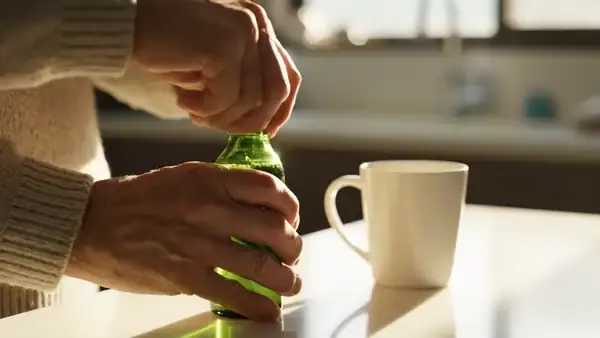
Then the fridge door, one cold bottle, cap off, two swallows.
It tastes like grassy green tea with a little sugar, and some mornings that's welcome and some mornings it isn't.
Breakfast is a real one, with somebody to talk to if he's lucky.
He keeps his usual coffee, but just the one cup today, because the bottle already counts as half.
Then a walk.
Twenty minutes around the block with the dog, before the day starts asking for things.

Nine thirty is the part of the day that needs him.
The bills, the insurance call, the long article he's been saving, the drive across town.
That's the window the caffeine is for.
If the bottle does its job, this is where he'll notice it, and if it doesn't, this is where he'll notice that too.
Two o'clock, nothing with caffeine after it.
Not the bottle, not the coffee, not the iced tea at lunch.
Lunch is lunch, ideally something with a vegetable in it.
If the afternoon drags, a short walk or ten minutes outside does more at that hour than any cup.
And at the end of the day, one line in a pocket notebook.
What he was doing at ten, and how it went.
That's the whole routine. A bottle, a walk, a notebook, and the same good habits as before.
Notice what's doing the heavy lifting there.
The water, the walk, the breakfast and the two o'clock rule cost nothing, and they'd help with or without the bottle.
The bottle is the small extra on top.
If you think of it that way, you'll judge it fairly.
And on the easy days?
Skip it.
A Saturday with nothing on the calendar but a ball game and a nap doesn't need a bottle.
Fifteen bottles saved for the mornings that ask something of you will stretch across a month, and you'll learn more from the contrast than from drinking one every day.
That's the other quiet advantage of a small bottle.
You can decide each morning, standing at the fridge door, whether today is a bottle day.
The Big Part Isn't in the Box
I've spent most of this page on a two-ounce bottle.
So in fairness, here's what the larger studies say about the habits around it, because those are the part that moves the needle.

Water.
Beyond the Berlin study, a review of 18 studies in adults over 60 found some evidence, though thin, linking being short on fluids with poorer scores on thinking tests. [19]
Thin evidence for a glass of water that costs nothing is still a bargain.
Keep one by the coffee maker and drink it first.
The plate.
In a three-year trial of 604 older adults, the group eating the MIND pattern, with its leafy greens, berries, beans, nuts, whole grains, olive oil and fish, improved its thinking scores. [20]
Here's the honest part: the comparison group, eating a little less without the MIND menu, improved almost as much.
So the lesson may be less about one perfect menu and more about eating like a grown-up most of the time.
In a Brazilian study that followed 10,775 adults for about eight years, the ones who ate the most ultra-processed food lost ground on thinking tests faster than the ones who ate the least. [21]
That's an association across a big population, not a sentence on your breakfast.
The evening glass.
In 550 British civil servants followed for thirty years, heavier drinking went with faster slipping on a word-fluency test, and light drinkers had no edge over men who didn't drink. [22]
None of these costs a dollar, and all of them have more behind them than any single bottle.
If you do nothing else after reading this page, do those.
Water first, a real plate, less from the vending machine, a lighter evening glass. The bottle, if you buy it, sits on top of those, not in place of them.
Who It Suits, and Who It Doesn't
This is worth a look if:
- You want a measured 55 milligrams of caffeine with a day's vitamins in a cold bottle you can drink in two swallows.
- You like the idea of matcha and don't like making it.
- You want a company with a street address in Venice, California, a phone number, an email and shipping at no charge. You have all four now.
- You can hold two ideas at once: a well-made drink, and a blend that doesn't print its amounts.
- You'll buy one box, use it on the busy mornings, and keep a notebook for a month.
Give it a miss if:
- You want to know exactly how much lion's mane, bacopa or citicoline you're drinking. This label won't tell you.
- You're sensitive to caffeine, or already at your limit of coffee.
- You want something that acts on a condition a clinician has named. This is a dietary supplement.
- You're counting sugar, or you travel without a fridge.
- You take anything daily and haven't shown a pharmacist a blend with nine names. Ask first; it takes two minutes.
Fair Questions About Price, Taste and Time
Every man I've talked to about this bottle has the same few questions.
They're good questions, so here are straight answers.

Isn't five dollars a bottle a lot for half a cup of coffee?
It is, if all you want is caffeine.
The day I read the seller's page, a first box of fifteen worked out to about five dollars a bottle, with the larger boxes a little less per bottle.
You're paying for the vitamins, the matcha, the nine names and the convenience of a cold bottle, and only you can say whether that's worth it on a busy morning.
What does it taste like, honestly?
Grassy, a little sweet, a little bitter.
Most reviews are fine with it.
One five-star buyer, Julie, loves the results and says it tastes pretty bad, which tells you a lot about both.
How soon would I notice anything?
The caffeine, within the hour, the way your coffee does.
The blend is a different story.
The trials behind those nine names ran for weeks or months at their own amounts, so a box of fifteen isn't a fair test of them, and I won't pretend it is.
What about the sugar?
Three grams of added sugar per bottle, six percent of the day, printed on the label.
That's less than a teaspoon, about a fifth of a cookie, and it's why the drink isn't harsh.
If you're counting sugar, count it: fifteen bottles is 45 grams over the box.
And the fridge?
The bottle is perishable, and the seller says to keep it cold.
It's a fresh drink, not a shelf-stable capsule.
That's fine if your fridge door has room and less fine on a road trip.
Isn't this just a fancy energy drink?
Not quite, and the difference is worth a sentence.
A typical canned energy drink can carry several times this caffeine and a lot more sugar.
This is 55 milligrams and three grams, in two ounces, with five vitamins and a blend alongside.
I already drink green tea. Why would I need this?
You might not.
A good cup of green tea gives you caffeine and theanine for pennies, and the National Institutes of Health notes green tea has caffeine in it. [14]
What the bottle adds is the vitamins, the other eight names in small amounts, and the convenience of not brewing anything.
Why not buy lion's mane or bacopa on its own?
If what you want is one ingredient at the amount its study used, that's a fair route, and a single-ingredient label will print the amount.
This bottle is a different idea: a little of many things, in one cold drink, in the morning.
Know which of the two you're shopping for, and you'll be happier with either.
Do I have to sign up for a subscription?
No, and I'd suggest you don't at first.
The seller's refund applies to your first purchase, and a subscription reorder that has already shipped doesn't get it.
One box, bought on its own, keeps everything simple.
A Hundred Days, Nothing to Send Back, on the First Box
This is the best refund page I've read this year, and there's one word in it that matters.

The seller's page says to use it for a hundred days, and if you're not satisfied, to ask for a refund.
You don't ship anything back.
The refund policy says the same in plainer words, and adds the part that matters.
It applies to your first purchase, and the seller doesn't refund subscription reorders cancelled after they've shipped.
The product is perishable, so there are no returns at all; the refund is the whole of it.
One hundred days, no questions, nothing to mail, on the first box.
How would I actually ask for it?
The seller prints a phone number that answers from nine to five, Pacific time, and an email address on its contact page.
Keep your order confirmation, write the date you started in the front of the notebook, and you'll have everything you need if you decide to ask.
That's a generous promise with one condition, and the condition is the word "first."
Buy one box on its own, and the promise is yours in full.
A hundred days, nothing to send back, once. It's built for the first box, and that's exactly how I'd use it.
If You Do Buy It: One Box, the Busy Mornings, One Notebook
If you're going to spend the money, spend it as a test with a date on it.
- Buy one box of fifteen, not a subscription. The hundred-day refund is for the first purchase.
- One bottle on the mornings that need it, not every morning. Fifteen bottles used that way cover about a month.
- Nothing with caffeine after two, the same as before. The bottle counts as half a cup.
- Keep your coffee exactly as it was for the first two weeks, so you know what the bottle adds. Cut the afternoon cup in the third and fourth weeks, so you know what that does.
- Write one line a day in a notebook. Not "sharper" or "slower," but what you were doing at ten and how it went.
- On day thirty, read the thirty lines. If the bottle days read better, you've found a habit you like; if they don't, the refund page says to ask, and you don't mail anything.
Look at that list the way I do.
Four of the six things cost nothing.
The box is the one you'll pay for.
The notebook and the two o'clock rule are the ones that will tell you the truth.
Why a notebook, of all things?
Because memory, of all things, is a poor judge of memory.
Ask any man how his mornings went last month and he'll tell you about the best one and the worst one.
The twenty-eight in between disappear, and they're exactly the ones you need.
One line a day solves that without any effort.
"Paid the bills, took twenty minutes, easy." "Long article, read it twice, slow start."
After thirty days, you're not guessing.
You're reading your own handwriting, and that's the most honest review this bottle will ever get.
Short Answers Before Your First Box
Questions readers ask
Is this a medicine?
No. It's a dietary supplement, a small cold drink of matcha, vitamins and a blend, and it isn't meant for any health condition.
How much caffeine is in it?
Fifty-five milligrams per bottle, about half a cup of coffee. Count it with your coffee and keep both before two.
How much of each ingredient is in the blend?
The label prints one weight, 1,925 milligrams, for all nine names together. It doesn't give an amount for any one of them.
Does it have sugar?
Three grams of added sugar and 25 calories per bottle, both printed on the label.
Will it help my memory?
I can't promise that, and I'd be wary of anyone who does. The caffeine has the strongest record, and it's for alertness.
Can I take it with what I already take every day?
Show the label to your pharmacist first. A blend with nine names and 55 milligrams of caffeine is exactly what they like to see written down.
Does it ship to me?
Within the United States at no charge, the seller says. It's perishable, so it goes in the fridge when it arrives.
Is there a version without caffeine?
The seller lists one with no caffeine and a stronger one with 165 milligrams. This page is only about the Original, at 55.
How many bottles come in a box?
Fifteen, thirty or sixty. I'd start with fifteen.
Should I drink one every day?
The label says one a day in the morning. I'd keep it for the mornings that need it, which makes a box of fifteen last about a month.
What if I don't like it?
On a first purchase, ask for a refund within a hundred days, and you don't send anything back. It doesn't apply to subscription reorders that have already shipped.
What 274 Buyers Say, Including One Who Wasn't Impressed
The seller's page shows 274 reviews, and each of the ten most recent, which is what the page loaded for me, carries the store's own buyer mark.
Of those ten: six at five stars, one at three, one at two, and two at one.
I kept four, including the two-star one, because he says in one sentence what this page takes a few thousand words to say.
I left out one that uses a word for this category that this page won't use, one about a delivery that never came, and three that don't say anything about the drink.
These are real customers, quoted word for word from the seller's product page; the small photos beside them are illustrations, not the reviewers.

I am amazed. Best product on the market for energy.

Quick, easy start to my day. This works!

Love the results! But it tastes pretty bad…

With all the hype, I thought this would hit harder. For me, it was no more than a half cup of coffee or green tea. Just being honest—didn't live up to it.
Read those the way I did.
Andrew is amazed, and says "energy." That's the caffeine, and I believe him.
Ruth calls it a quick, easy start to the day.
That's a routine, and a bottle in two swallows is an easy one.
Julie loves the results and dislikes the taste, in one sentence, which is more honest than most five-star reviews manage.
Bill, at two stars, found it no more than half a cup of coffee or green tea.
That's 55 milligrams of caffeine, described by a man who never saw the number.
Two describe mornings, one describes a taste, and one describes half a cup of coffee, which is exactly what the label adds up to.
From Venice, California, With Shipping at No Charge
The bottle is sold by Magic Mind on its own website, and that's the only place this page links to.

The company is easy to find.
It's registered as 10,000 Inc., with an address on Electric Avenue in Venice printed at the foot of its site, a phone number that answers on Pacific time, and an email.
Its privacy page gives a second address in San Francisco, which I mention because I mention everything.
The current price is shown on its page, not here, and it ships at no charge within the United States.
Why does it matter who's behind the bottle?
Because a company with a street address, a phone number and a written refund page is a company you can call.
I'd rather buy anything, from a drink to a lawnmower, from people who print where they are.
Magic Mind prints it, and that counts for something.
What a Small Green Bottle Is Worth to a Man Like You
Here's the whole thing in one breath.
A well-made cold drink from a company with an address and a phone number, with five vitamins printed plainly and half a cup's worth of caffeine.
A blend with nine good names and one weight, in amounts the label keeps to itself.
Three grams of sugar, a life in the fridge, and a taste one fan calls pretty bad.
And a refund that's the most generous I've written about, exactly once.
A measured half cup of caffeine, a day of vitamins, and a little of nine good names.
So who should buy a box?
A man who drinks coffee already, wants a smaller and steadier dose on the mornings that matter, likes the idea of a day's vitamins alongside, and doesn't mind paying for the convenience.
And who should keep his money?
A man who wants every amount printed, a man who's already at his caffeine limit, and a man hoping a bottle will do what water, a walk and a good plate haven't.
If you're in the first group, you now know more about this bottle than most people who buy it.
If you're in the second, you've saved yourself the price of a box, and I'm glad of that too.
If you're a man who wants that in a cold bottle for the mornings that need it, it's worth one box of fifteen.
Buy one box, not a subscription, use it on the busy mornings, and write one line a day for thirty days.
The notebook is a better judge than I am, and the label is a better judge than the listing.
One box of fifteen, for a month of busy mornings
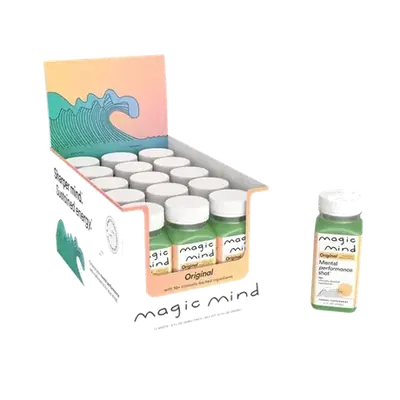
A small daily bottle of matcha, vitamins and a proprietary blend from a Venice, California company, with about half a cup of coffee's worth of caffeine.
SEE THE BOX OF FIFTEENSold and shipped at no charge within the United States by 10,000 Inc. (Magic Mind), Venice, California · Perishable; keep cold · 55 milligrams of caffeine per bottle · Refund within 100 days on your first purchase, with nothing to send back; not on subscription reorders already shipped
P.S. If you take one thing from this page, take the two numbers.
Fifty-five milligrams of caffeine, the line with a record, and 1,925 milligrams of blend, the line without amounts inside it.
P.P.S. If the small slips have been bothering you for a while, or someone close to you has mentioned them, a conversation with your own clinician is worth more than any box.
A bottle on a busy morning is a small habit, and that's all it was ever meant to be.
P.P.P.S. And if you do order it, keep the notebook, and keep the bottle before two.
When the box is empty, you'll have thirty lines about your own mornings, and that's worth having whichever way they turn out.
First purchase only · refund within 100 days with nothing to send back
The ingredient and advertising guide linked at the foot of this page goes through every line on the panel, the five vitamins and the nine names in the blend, and says which have a printed amount and which don't.
Print it and take it to the pharmacist if you take anything daily; it's written for that.